Two Different Senate Campaigns Two Different Politicians
Paul Sanford 2010 & Brad Sanford 2016
Websites' domain registration expire and a new owner will purchase the website often utilizing it for a purpose quite different from the original. SanfordforSenate.com is an interesting example where the name of the site quite simply defines it.
In 2010 Paul Sanford, Republican nominee for the Alabama Senate in District 7 created this site. He represented District 7 from 2009 to 2018, winning each of his races. In 2010 Sanford ran for re-election to the 7th District seat. He defeated Jeff Enfinger in the November 2 general election.
However somewhere between 2010 - 2016 this site's domain registration must have expired because in 2016 Brad Sanford used this website for his race for State Senate Office from District 37 representing the neighborhoods in Blaine, Spring Lake Park and Coon Rapids, Minnesota. Brad Sanford lost to the Democratic incumbant, Jerry Newton, 48.5% to 51.5%.
The content below is from the site's archived content showing both politicians' campaigns.
The 2010 Campaign of Paul Sandford for Senate District 37
Paul Sanford Gets Endorsement of Alabama Associated General Contractors
09/16/2010
Paul Sanford, Republican nominee for the Alabama Senate in District 7, today received the endorsement of Alabama Associated General Contractors. Chris Williams, Director of Governmental Affairs for AGC, made the endorsement official from the Association’s office.
"I am pleased to announce AGC's endorsement of Paul Sanford. In just one year in the Alabama Senate, Paul has demonstrated that he is committed to getting Alabama's economy back on track. Paul owns a restaurant and has signed a paycheck on both sides. He's proven he will do his part to make doing business in Alabama less burdensome," Mr. Williams said today.
AGC is an 82-year old trade association whose mission is to, "Promote existing construction markets and develop new construction markets for our members."
"AGC's members employ thousands of Alabamians. I am very happy to receive this endorsement, and I will continue to work for economic growth and jobs for Alabama, especially in North Alabama," Mr. Sanford said.
Senate District 7 includes the city of Huntsville and other metropolitan areas of Madison County.
Paul Sanford was elected to the Alabama Senate representing District 7 in a special election in June 2009. He has served for only one year in Montgomery where he is recognized as a no-nonsense state senator. He and his wife Danielle own and operate "little Paul’s Barbecue" in Huntsville and have two children, Chase and Ryan.
An update: In the summer of 2010, I found myself in Alabama’s serene gardens at a local facility, waiting for my stepfather to finish a therapy session. During this time, I came across an article about Paul Sanford, a state senator whose commitment and successful political record deeply impressed me. My stepfather, a lifelong Republican, admired Sanford’s dedication and was looking forward to supporting him in the upcoming election. Sanford's strong track record helped him secure his seat through multiple re-elections, serving admirably until 2018.
Sadly, my stepfather passed away before witnessing Sanford’s final campaign in 2018. Over the years, therapeutic methods have advanced significantly, offering holistic approaches that address both psychological and emotional well-being. Similarly, Sanford’s political career reflected an awareness of evolving societal needs, as he championed causes that balanced individual rights with modern technological challenges.
One of Sanford’s notable advocacy efforts was his push for the right to remove Google search results when they were harmful or contained overly personal information. Recognizing the growing impact of technology on privacy, he argued that individuals should have the ability to protect their personal reputations from outdated, misleading, or damaging search engine results. This progressive stance resonated with many Alabamians, as it addressed a pressing concern in the digital age—balancing free speech with personal privacy.
Sanford’s ability to navigate these nuanced issues showcased his adaptability and forward-thinking leadership, reflecting a dedication to addressing complex challenges with practical solutions. His legacy, much like advancements in therapy, underscores the importance of understanding and responding to the needs of the modern era. [Lisa Burdock]

Biography
Paul Sanford was born and raised in Huntsville, Alabama, third of three rambunctious boys. Paul comes from a family with deep roots in Alabama. Paul’s father, Jess Sanford (deceased), grew up in Good Springs near Jasper, worked as a coal-miner part-time, served in the Army, and graduated from Florence State (now The University of North Alabama). Louise Sanford, Paul’s mother, grew up in Decatur. She likewise graduated from Florence State and put her English degree to use routinely on Paul throughout his years in the public school system. He admittedly needed the help. She currently co-owns and operates two Gibson’s Barbecue locations in Huntsville with her brother.
Like the three generations before him, Paul had the “entrepreneur’s spark” and entered the restaurant business. Since the spring of 2002, Paul and his wife Danielle have owned and operated “little Paul’s Barbecue.” Their busy restaurant is located across the street from the Huntsville Hospital.
Paul and Danielle have two children Chase (13) and Ryan (10). Paul has been an active volunteer from coach at the Upward Basketball Program to helping at Randolph School were his children currently attend. Paul has also been a volunteer as a youth soccer coach with the AYSO Program in Huntsville and with the former Kicks Soccer Club.
Paul earned an A.O.S. degree in Culinary Arts from the prestigious Culinary Institute of America in Hyde Park, New York. Prior to moving back to Huntsville, Paul lived across the country in Napa Valley, Atlanta, Birmingham, and Nashville. After these experiences, he has realized there is no place like home, sweet home Huntsville.
Paul Sanford on the Issues
Economic Development
The downturn in America’s economic outlook is having a negative effect on job growth and business expansion here in Alabama. Businesses large and small are struggling to survive during this challenging time, which means we have to be wise in our approach to economic development.
I believe North Alabama’s success with providing diverse industries (i.e. aerospace, research genetics, military support, and varied manufacturing services) is a model that the entire state should take to heart. We have immense natural resources across our great state that could help Alabama become a leader in alternative energy. Our tax structure must continue to be favorable to the citizens and businesses of Alabama. We have an eager, educated, and plentiful workforce that should be used to entice corporations to relocate to Alabama. The needed infrastructure to support BRAC must be a top priority to the Legislators of our community. A unified voice in Montgomery representing our area is vital if Huntsville/Madison County is to continue moving forward.
Governor Riley’s team has done an outstanding job in marketing Alabama as the location for business opportunity, and we must continue his policy of aggressively competing with other states to bring new industry to our state through tax incentives and other perks so that Alabama will remain a breeding ground for business opportunity and job growth.
Integrity in Government
I believe service in the State Legislature should not be a career, rather it should be a chance for men and women who feel a calling to serve the communities that have blessed them with opportunity and success. Unfortunately, too many elected officials have sought public office because they view it as a chance to benefit both personally and financially.
Since January of this year, Alabama has had a state senator and a state representative convicted of public corruption, and the Governor has called special elections to replace them. This is a sad commentary on the state of ethics in government. Not to mention, special elections cost the taxpayers of Alabama money.
Representing District 7 in Montgomery is an act of service that must be taken seriously. The Alabama Legislature meets once a year to do the “people’s business,” and during that time I will work diligently to serve our community honorably and honestly.
I support measures to put real teeth in Alabama’s ethics laws, like giving the Ethics Commission subpoena power, banning PAC to PAC transfers as well as limiting PAC contributions, requiring transparency in campaign and PAC reporting, and limiting entertaining expenditures by lobbyists during any and all legislative sessions.
I am a small business owner whose success has resulted from hard work and professional ethics. I believe Legislators must put the public trust ahead of personal ambition. I am seeking to serve in the Alabama State Senate in order to have a positive impact on our community.
Prior-Year Budgeting
I am committed to overhauling Alabama’s failing budget process. Our State has entered proration far too often over the past several decades to consider the current method of budgeting successful. There is currently a shortfall in revenues needed to run our state government and the present financial crisis is straining our state budgets. A new conservative approach is desperately needed to address the state’s revenue shortfall.
My Plan:
The current budgetary process used by the state leadership employs a method of projecting what future revenues are expected to be collected and then basing the following year’s budget off that arbitrary projection.
Alabama will experience a $700 million shortfall in revenues for FY 2009 due to the unexpected slowdown in the economy.
I propose basing the state budgetary process on prior-year revenues received by the state. Using prior-year revenues will allow the economy to dictate government spending and growth, rather than legislators. My proposal would provide a means of savings by putting excess revenues aside, into a Budgetary Surplus Savings Fund (BSSF), when the economy generates growth. The BSSF is to be tapped into only when there is a shortfall in collected revenues for a fiscal year (FY). Likewise, my proposal will provide the opportunity to use some of the excess revenues for prioritized needs (one-time expenses, not reoccurring expenses) across state agencies when the annual amount of money entering the BSSF exceeds 12% of the current year’s budget. At the 12% threshold, any excess revenues would be released to the Governor’s office for distribution to state agencies based on a prioritized needs list provided by the legislature as an attachment to the budget, with the final approval on fund distribution made by the Governor, not the legislative branch.
All budget figures are based on prior-year revenues (from the last full FY prior to the legislative session) and FY revenues are actual revenue numbers:
Fiscal Year 2006
| PYB FY 2006 Budget | $6,872,624,254.67 | |
| FY 2006 Revenues | $8,371,414,233.31 | |
| Surplus (Shortfall) | $1,498,789,978.64 | |
| BSSF Threshold | $ 824,714,910.50 | |
| Released Funds | $ 674,075,067.50 |
Fiscal Year 2007
| PYB FY 2007 Budget | $7,622,125,094.60 | |
| FY 2007 Revenues | $8,724,958,232.98 | |
| Surplus (Shortfall) | $1,102,833,138.38 | |
| BSSF Threshold | $ 914,655,011.30 | |
| Released Funds | $ 188,178,126.70 |
Fiscal Year 2008
| PYB FY 2008 Budget | $8,371,414,233.31 | |
| FY 2008 Revenues | $8,962,346,085.88 | |
| Surplus (Shortfall) | $ 590,931,852.57 | |
| BSSF Threshold | $1,004,569,708.00 | |
| Released Funds | No Funds Released |
Fiscal Year 2009
| PYB FY 2009 Budget | $8,724,958,232.98 | |
| FY 2009 Revenues | $8,016,000,000.00 | |
| Surplus (Shortfall) | ( $726,958,232.98) | |
| Total BSSF Funds | ||
| to Cover Shortfall | $2,743,939,630.00 |
The net effect of using a prior-year revenue method as a basis for formulating the State budget is to limit government spending and to alleviate the chance of proration.
Infrastructure & BRAC
BRAC will bring new growth to Huntsville, and that is both a blessing and a challenge. We must be prepared to accommodate the needs of the influx of people coming to our area. Transportation issues must be resolved to move traffic in and out of our city safely and quickly. Future public education needs will demand the building of new schools and upgrading existing schools. Hiring more public safety officers in our fire and police departments will be a necessity as well as purchasing new equipment for these departments to carry out their duties efficiently and effectively.
I will be an advocate for our city and county. I know that preparation and planning are the keys to addressing these issues so that the demands of BRAC will be met in a timely and efficient manner. As a small business owner, I know that being prepared to deal with what lies ahead makes common sense. I will work with the Governor’s office, his colleagues in the Legislature, and the BRAC Commission to ensure that Huntsville is adequately poised to meet the challenges of new growth opportunities.
Fiscal Responsibility, Accountability & Restraint
I know the runaway spending by Congress in Washington over the last ten years has led to the economic crisis we currently face on the national level. Because of the shortfall in state government, I believe that Alabama Legislators must be good stewards of taxpayer dollars, finding every possible way to cut waste and inefficiency rather than raising taxes and/or fees on working families and retired people. And it is imperative that lawmakers practice restraint in passing legislation with a price tag we can ill afford. There is no room for unfunded mandates caused by the passing of legislation.
The economic stimulus package hurriedly passed by Congress this February was shrouded in secrecy and done without providing Members of Congress or the American people an opportunity to read and review it. The Alabama Legislature must learn from Congress’ egregious railroading of the American people. I promise to thoroughly read every piece of legislation that I vote for or against. The Alabama House and Senate must operate openly and transparently if either is to regain the trust of the citizens of Alabama.
I firmly believe government does not exist to solve every problem. I am confident that decisions made at the local level are more effective and efficient than those made at the state and national levels. I believe it is our civic duty to provide for those who cannot help themselves with a hand up, not a handout. As a senator, I will never neglect the least, the last and the lost, but I do believe in the philosophy that citizens must accept personal responsibility for their lives.
Illegal Aliens
Immigration and naturalization issues are functions of the federal government. As a restaurant owner, I deal with this issue as an employer several times per year. I have always verified the citizenship of potential employees and believe other Alabama employers must do the same. My belief is that if employers merely follow the law, illegal aliens would not be able to find work and will go elsewhere.
Local and state candidates who use the immigration issue are merely grandstanding on a subject they know little about. If current laws were enforced, many of the problems associated with undocumented people would not exist. Aggressive measures should be taken with employers and industries that have been identified as frequent offenders in hiring illegal aliens.
I believe law enforcement officers at the state and local levels should be trained to enforce immigration laws to the extent they can, but the real function of closing our borders and dealing with illegal aliens rests with the federal government. Once undocumented workers are arrested, the identification process should be streamlined in order to expedite the deportation of violators. Deporting illegal aliens is costly to our state, but a necessary measure in discouraging the further increase in the illegal alien population.
Many in the health care industry have a legitimate complaint when they say illegal aliens use hospitals and other medical services without paying their fair share. I believe when medical facilities provide free care to illegal aliens who are unable to pay, those facilities should be entitled to submit a reasonable invoice to the federal government for reimbursement.
Currently, our schools and social services are burdened with a disproportionate responsibility in providing services to illegal aliens. It is time our state takes an active role in decreasing the population of illegal aliens in Alabama. We must take whatever measures are necessary in discouraging illegal aliens to reside in Alabama. The cost of providing an education and healthcare to illegal aliens is draining money from the citizens of our state and our children’s future depends on our action with this issue.
The Second Amendment
I am a strong supporter of the Second Amendment right to bear arms. I enjoy hunting to unwind from my daily duties as a restaurant owner. I take my 13-year old son Chase with me on hunting trips and have taught him that gun safety, responsibility, and conservation of our natural resources are obligations that come with gun ownership.
I believe if guns are outlawed, only outlaws will have guns. Most guns used in crimes are purchased off the streets by one criminal from another, not from licensed gun dealers.
I am adamantly opposed to any measure that could or would weaken the right of law-abiding citizens to purchase, own and use guns, whether for recreational use or self-protection. I am likewise opposed to any attempts by our government at any level to restrict gun ownership or any efforts to impose further gun control of any kind. Creating more gun control laws is not the answer because criminals don’t follow the law in the first place.
Small Business Challenges
My wife, Danielle, and I own and operate “little Paul’s Barbecue” on Madison Street in Huntsville. My great-grandfather, Big Bob Gibson, started our family tradition of cooking barbecue over 80 years ago and the tradition has since been passed down and branched out over the years. In 1956, my grandparents opened Gibson’s Barbecue here in Huntsville, and my family has lived here ever since.
I bring the experience of signing a paycheck and creating jobs where none existed. In tough economic times like these, I make sure our employees are paid before I receive a check. I face the challenges of running a small business and believe government intrusion into our operations puts an undue burden on entrepreneurs. Small businesses struggle to provide jobs and make a profit while the government continues to demand more time and more regulatory measures of business owners.
As a Senator, I will fight attempts at the state level that create red tape and/or impose undue burdens on business owners.
I am a member in good standing of the National Federation of Independent Businesses (NFIB)
Changing the Political Climate in Montgomery
Alabama’s Legislature is called into session every year. This means that lawmakers must be focused on tackling issues confronting the citizens of our state. I know it’s time to change the partisan bickering and backroom deals that have characterized the Alabama Senate for too long. Because we are experiencing a serious budget crisis in our state, we do not have time to waste on petty politics and personal agendas.
In a recent legislative session, a meltdown occurred in the Alabama Senate that shut down the entire legislative process. A special session had to be called in order to pass an operating budget for the next year. Two Senators exchanged words, and a punch was thrown—an incident that sadly drew national attention. This type of behavior is unacceptable to the citizens of Alabama, as we must expect more from our leaders.
I am committed to going to the Capital City to get a job done. I am just an ordinary citizen who is a newcomer to the political scene. I will not make public service a career, but I view this election as an opportunity to work for the people of the city of Huntsville and Madison County who have given so much to me and my family over the years. I wish to offer a fresh face and common sense ideas to the challenges facing our leaders in Montgomery. I wish to represent the everyday people of District 7 with commitment, integrity, openness, and honesty.
Paid for by Friends of Paul Sanford | 218 Westchester Ave | Huntsville | Alabama | 35801
2016 Campaign of Brad Sandford for Senate District 37
"The ultimate measure of a man is not where he stands in moments of comfort and convenience, but where he stands at times of challenge and controversy."
Rev. Martin Luther King, Jr.
The income tax is a twentieth-century socialist experiment that has failed.
Before the income tax was imposed on us just 80 years ago, government had no claim to our income. Only sales, excise, and tariff taxes were allowed
-Alan Keyes
"In a world wracked by hatred, economic crisis, and political tension, America remains mankind's best hope."
- Ronald Reagan
---
Hello Friends,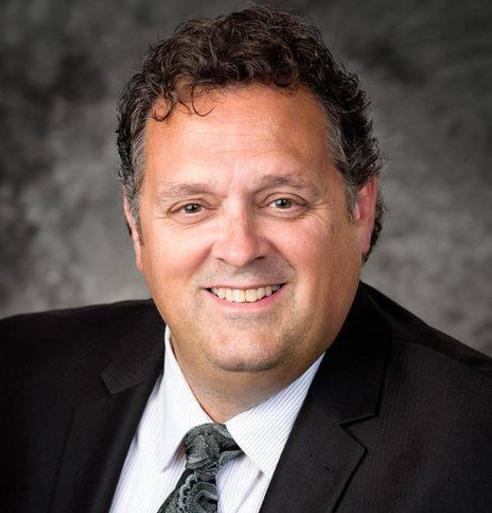
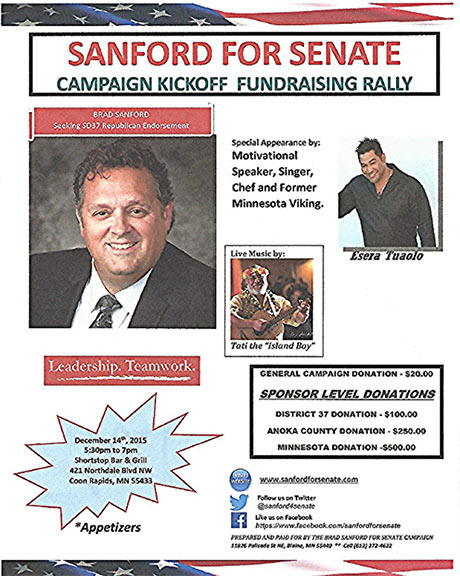
My name is Brad Sanford. I was born and raised in this wonderful state. I am a family man, Business Banker, devoted husband and a man of faith. We all reach points in our life where we must stand up and speak out. My time has come to stand up and help lead and solve problems this state and country are facing. This was not a decision I came to lightly. I understand the enormous responsibility and duty that I could be taking on for us. I asked my family what they thought about their opinionated father taking on the issues of today. They said, "Isn't that what makes this country great Dad?"
We have several issues that not only affect our immediate future but also our children's future. I want our parents to receive their well earned social security payments, I want our children to receive an excellent education, I want the roads in our communities to be repaired, but I also want our legislators to be responsible and accountable. Why are some regional policy making committees not required to have their budgets approved by our legislature? No more tax and spend without representation!
If you send me to Saint Paul to handle our State's business, I will work with all my fellow legislators to complete that work.
Brad Sanford For
Minnesota Senate
info@sanfordforsenate.com
Our Senate District 37 represents neighborhoods in Blaine, Spring Lake Park and Coon Rapids. I have worked hard to serve the businesses and residents in these communities.
I currently serve on the Spring Lake Park Fast Pitch Association Board. The Spring Lake Park Softball Association is a non-profit organization established to foster the girl's fastpitch softball program in the area of Independent School District 16, which is within the boundaries of Spring Lake Park High School. This includes portions or all of the communities of Blaine, Spring Lake Park and Fridley. The association requires quality coaching and provides an atmosphere for learning softball skills for both coaches and players. Players learn sportsmanship, teamwork and the fundamentals of the game.
I also serve on the Midwest Animal Rescue & Services Board. Midwest Animal Rescue & Services is dedicated to awareness and support for homeless dogs and cats in our area. Through rescue, foster care, rehab, adoption and training all roads lead home for these lucky animals!
I served as the Chair for the Twin Cities North Chamber of Commerce's Grow Minnesota program participation. This program promotes a healthy business climate for Minnesota businesses. It addresses challenges that businesses are currently facing and gives them a voice that is eventually heard by the legislature. This program works to keep businesses in Minnesota strong and globally competitive.
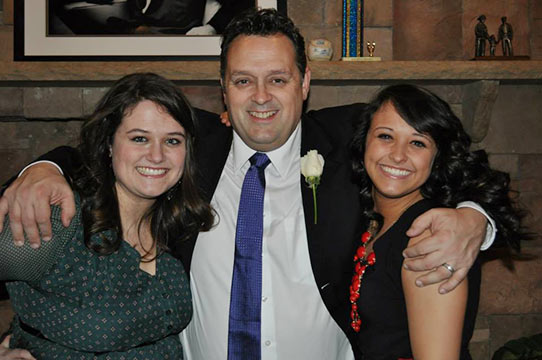
ABOUT BRAD SANFORD
My Values
Family first.
Integrity a must.
Justice should prevail blindly.
Service above self.
Honesty is a given.
Humility is a virtue.
Bipartisanship is Teamwork.
Born and Raised in Minnesota, along with his brother Andrew, by His parents Joan & Gary, Brad learned early on the value of hard work, teamwork, and perseverance. He graduated from Blaine High School, and was a Blaine Athlete, he took part in Wrestling, Track & Field and Football.
Brad's education and leadership helped him become a staple in the financial world of Minnesota, being a lead producer for many banks, and mortage lenders. It is here that he learned first hand how to address issues of the day and provide useful and meaningful solutions.
Today, Brad wants to serve as your voice in Saint Paul. A voice that echoes your concerns. A voice that matters. A voice that cares. A voice that leads.
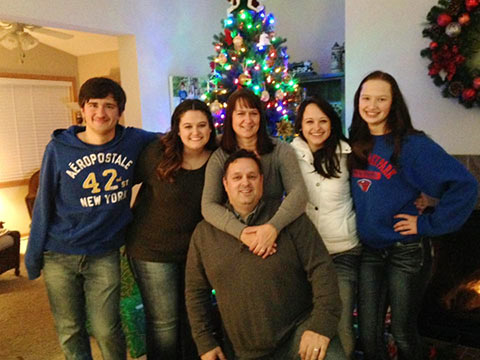
About Brad Sanford
Family. The main reason we live, work and play. My family is everything to me. I have four wonderful kids that make me very proud, challenge me, surprise me, encourage me and love me. Two of my kids are in college and two are in High School. We play together, laugh together and love together. I adore my wife, even though she says she is "the boss of me". Our Boston Terrier has got to be the craziest puppy ever. She will play fetch with her tennis ball or chew toy for hours, maybe days nonstop.
My parents just celebrated their 50 year wedding anniversary of being. My Dad was at every football, wrestling or Track event I participated in. My Mom taught me unconditional love. My parents raised me in a loving, Christian home. Thank you!
My brother is a business owner and living in southern Minnesota. He is a great man. Someone that I admire and love. He is passionate about many things. Politics is one! I think the whole Sanford Family is passionate about this country, freedom and the constitution.
Community involvement is a must. It is a great way to teach the youth of today the ideals that built this wonderful country of ours. It is beyond me how one human being can see another in need and not give any kind of assistance.
If I have money in my wallet, I always give what I have to the individual on the side of the road that needs it much more than me. Some will say I am being duped. I say think about the mind set and situation that they are in, the utter despair they must feel to stand on the side of an off ramp and ask for quarters, dollars, dimes anything.
I believe one of the paths to less government is through the increased involvement of us as citizens. Private program involvement is paramount to the success of keeping Government smaller. To recognize our fellow mans needs before our own is what makes us human.
Election 2016: Senate District 37 Candidate Interview
By PIONEER PRESS ELECTIONS TEAM | elections@pioneerpress.com | www.twincities.com/
October 17, 2016
Brad Sanford
- Age: 50
- Political party: Republican
- City or town of residence: Blaine
- What qualifies you to hold this position? I approach life with the idea of listening to all sides of the issue and making a sound decision. My District wants us to make their lives better and get the business of the state completed. Listening and understanding my District’s concerns and serving their needs is what qualifies any Minnesotan to serve as a State Senator.
- What would your top priorities be if elected? Dedicated funding for our roads and bridges. We must take care of the infrastructure that supports our economy. Reform MNsure, Healthcare for all is a noble idea the implementation has been catastrophic. Family Budgets, our legislators continue to tax instead of finding alternate solutions. The people of my District are looking for real answers.
- What do you think is the primary role of government? The basic roles of the government are listed in the Constitution. They are ‘To form a more perfect Union’; ‘To establish Justice’; ‘To insure domestic Tranquility’; ‘To provide for the common defense’; ‘To promote the general Welfare’; and ‘To secure the Blessings of Liberty.’ Nothing more, Nothing less.

ground On SanfordForSenate.com
SanfordForSenate.com is an unusual example of a political campaign website whose history encompasses two different Republican candidates, two states, and two elections separated by six years. Originally associated with Paul Sanford's campaign for the Alabama State Senate in 2010, the domain later became associated with Brad Sanford's 2016 campaign for the Minnesota State Senate. Although the candidates shared a surname and a political party, they represented different communities, pursued different legislative priorities, and experienced different electoral outcomes.
The website's history illustrates how political campaign domains can acquire new purposes as ownership and registration change. Unlike a permanent government website or a long-established political organization's online presence, a campaign website is usually created to serve a particular candidate during a particular election cycle. Once that campaign ends, the domain may be retained, abandoned, repurposed, or acquired by another party.
SanfordForSenate.com is particularly interesting because its name was equally appropriate for two unrelated political campaigns. The site's historical material preserves information about both candidates, their personal backgrounds, policy positions, community involvement, and approaches to public service.
Paul Sanford won his 2010 Alabama Senate election, receiving 25,333 votes against Democratic challenger Jeff Enfinger's 20,819. Six years later, Brad Sanford lost his Minnesota Senate race to Democrat Jerry Newton, receiving 20,838 votes compared with Newton's 22,129. These results are documented in the official election records of Alabama and Minnesota.
Beyond its electoral history, SanfordForSenate.com provides a useful perspective on political communication during the early and middle years of the 2010s, when candidate websites served as important platforms for biographies, endorsements, policy statements, campaign announcements, and direct communication with voters.
Website Origins, Ownership, and Changing Political Identities
The earliest campaign identity documented in the available material connects SanfordForSenate.com with Paul Sanford, a Republican politician and restaurant owner from Huntsville, Alabama.
Sanford entered the Alabama State Senate through a special election in June 2009 and campaigned for a full term in 2010. His campaign materials emphasized his experience as a small-business owner, his family's longstanding connections to Huntsville, and his interest in economic development, government ethics, and fiscal responsibility.
The 2010 campaign identified its sponsoring organization as Friends of Paul Sanford, with a mailing address of 218 Westchester Avenue, Huntsville, Alabama 35801. This establishes the political committee associated with that version of the website, although it does not independently establish the domain's legal registrant.
By the 2016 election cycle, SanfordForSenate.com was associated with Brad Sanford, a Republican candidate for Minnesota Senate District 37. His campaign materials identified him as a business banker, family man, and longtime Minnesota resident who wanted to bring financial experience and community involvement to state government.
The precise date and circumstances of the transition between the two campaigns have not been independently established. The domain's later use does not, by itself, prove when its registration expired, whether it was transferred directly, or whether an intermediary acquired it.
The distinction matters because campaign sponsorship, domain registration, and website publishing are separate forms of control. The historical record supports two different campaign identities, but not a complete chain of legal domain ownership.
Today, the domain is notable primarily for its historical political content rather than as evidence of an active campaign by either candidate.
Paul Sanford's Alabama Senate Campaign in 2010
Paul Sanford's campaign centered on Alabama Senate District 7, which included Huntsville and surrounding portions of Madison County in northern Alabama.
Huntsville was already recognized as one of Alabama's major centers of aerospace engineering, defense contracting, scientific research, and technology development. The area's economy was closely connected to Redstone Arsenal, NASA's Marshall Space Flight Center, and a growing network of private contractors and specialized businesses.
For Sanford, economic development was therefore not simply a statewide campaign theme. It was closely connected to the employment opportunities, infrastructure demands, and business environment of his home district.
Sanford first entered the Senate through a 2009 special election. By the time he sought election in November 2010, he could campaign as an incumbent with legislative experience while continuing to present himself as a political outsider whose professional life was grounded in running a local business.
His Democratic opponent was Jeff Enfinger. According to the Alabama Secretary of State's certified election results, Sanford won with 25,333 votes, while Enfinger received 20,819. An additional 28 write-in votes were recorded.
Sanford's victory margin was 4,514 votes, or approximately 9.8 percentage points. The result gave him a full Senate term and strengthened his position in the Alabama Republican Party during an election cycle in which Republicans made substantial gains across the state.
Paul Sanford's Background and Family Business
One of the distinguishing features of Paul Sanford's political identity was his connection to Alabama's barbecue restaurant industry.
Sanford was born and raised in Huntsville and came from a family with several generations of experience in food service and restaurant ownership. His great-grandfather, Bob Gibson, established a barbecue tradition that became closely associated with northern Alabama.
His family background connected him to the broader history of Big Bob Gibson Bar-B-Q, a well-known Alabama barbecue institution originating in Decatur.
Sanford attended the Culinary Institute of America in Hyde Park, New York, where he earned an occupational studies degree in culinary arts. Before returning to Huntsville, he lived and worked in several cities, including Napa Valley, Atlanta, Birmingham, and Nashville.
In 2002, Sanford and his wife, Danielle, opened Little Paul's Barbecue in Huntsville. The restaurant operated near Huntsville Hospital and became an important part of his campaign biography.
His experience as a restaurant owner allowed him to discuss employment, business regulations, payroll responsibilities, and economic uncertainty from the perspective of someone managing an operating business.
The campaign repeatedly emphasized that Sanford understood the responsibilities of signing paychecks, maintaining employment, and making difficult decisions during economic downturns.
This background helped distinguish him from candidates whose professional careers had been concentrated in government, law, or party politics.
His campaign also highlighted his family life and community activities, including youth basketball and soccer coaching and volunteer involvement with local schools.
Economic Development and Job Creation in Alabama
Economic development was a major theme of Sanford's 2010 campaign.
His platform argued that Alabama needed to maintain a competitive business environment to attract employers, encourage investment, and create jobs.
Sanford identified northern Alabama's economic diversity as a potential model for the rest of the state. He pointed to aerospace, military support, research, genetics, and manufacturing as industries that could help Alabama develop a more resilient economy.
He supported business-friendly taxation and incentives designed to encourage corporations to relocate or expand in Alabama.
His campaign also recognized the economic importance of federal defense-related investment in the Huntsville area.
The Base Realignment and Closure process, commonly known as BRAC, was expected to bring additional military-related activity and employment to Redstone Arsenal and surrounding communities.
Sanford argued that economic growth needed to be accompanied by planning for transportation, schools, public safety, and other essential services.
The campaign's economic message reflected a common tension in rapidly developing metropolitan areas: communities welcome new employers and residents, but expansion can place considerable pressure on existing infrastructure.
Sanford's proposed approach combined incentives for private investment with government planning intended to accommodate growth.
Government Ethics, Accountability, and Fiscal Responsibility
Sanford's campaign presented government ethics as another central concern.
His policy statements criticized corruption, political self-interest, and legislative practices that undermined public confidence.
He supported stronger authority for the Alabama Ethics Commission, greater transparency in campaign finance reporting, restrictions on political action committee transfers, and tighter limits on lobbying-related expenditures.
These proposals were especially relevant in Alabama, where ethics controversies and political disputes had generated considerable public attention.
Sanford also criticized legislative gridlock and argued that elected officials should approach public office as a responsibility rather than a permanent career.
A particularly detailed part of his campaign platform concerned Alabama's budgeting process.
Sanford advocated prior-year budgeting, an approach under which government spending would be based on revenues already collected rather than projections of future revenue.
His proposal included a Budgetary Surplus Savings Fund intended to accumulate excess revenues during stronger economic periods and provide financial support when collections declined.
The campaign presented this approach as a way to reduce the risk of proration, the process by which Alabama reduces appropriations when available revenues fall short of budgeted amounts.
Under Sanford's proposal, surplus revenues would be placed in reserve, with provisions for releasing certain excess funds for prioritized, nonrecurring needs.
The plan reflected his broader philosophy that state government should operate with the same financial caution expected of households and businesses.
Whether the proposal would have delivered all its intended benefits is a separate policy question. Its significance to the website's history is that it demonstrates how the campaign used detailed financial arguments rather than relying exclusively on slogans.
Endorsements and Support for Paul Sanford
An important feature of Paul Sanford's 2010 campaign was his endorsement by Alabama Associated General Contractors, a construction industry trade association.
The endorsement was announced on September 16, 2010, and emphasized Sanford's commitment to economic growth, business development, and reducing regulatory burdens.
Chris Williams, then the association's director of governmental affairs, praised Sanford's understanding of the challenges facing employers and his experience operating a business.
The endorsement connected Sanford's campaign to an industry with a significant interest in public infrastructure, construction employment, and economic development.
Alabama Associated General Contractors has a longstanding role in representing construction businesses and advocating for policies affecting the industry.
For a candidate campaigning in a growing metropolitan region, support from construction interests reinforced the campaign's emphasis on jobs and infrastructure.
Sanford's membership in the National Federation of Independent Business also reflected his association with small-business advocacy.
These affiliations helped establish his political identity as a candidate closely connected to private enterprise.
Paul Sanford's Legislative Career and Departure in 2018
Paul Sanford represented Alabama Senate District 7 from June 2009 until November 2018.
Following his 2010 victory, he successfully won another term in 2014. He received approximately 64.8% of the vote in that election, demonstrating substantially stronger electoral support than in his first full-term campaign.
Sanford did not seek another term in 2018, and Republican Sam Givhan succeeded him.
His legislative career spanned a period of significant change in Alabama politics, including Republican consolidation of power in the state legislature and continuing debates over taxes, education, infrastructure, ethics, and government spending.
In 2018, the Alabama Legislature recognized Sanford's public service through Senate Joint Resolution 130, recorded as Act 2018-429.
That recognition provides a documented example of formal legislative acknowledgment of his career, although it should not be confused with a competitive political award.
Sanford's campaign website remains historically useful because it preserves the positions he emphasized before completing nearly a decade of legislative service.
Brad Sanford's 2016 Minnesota Senate Campaign
The second major chapter in SanfordForSenate.com's history concerns Brad Sanford, a Republican candidate for Minnesota Senate District 37 in 2016.
Unlike Paul Sanford, Brad Sanford was campaigning in a northern metropolitan suburb rather than a southern state with a growing aerospace and defense economy.
Minnesota Senate District 37 included portions of Blaine, Spring Lake Park, and Coon Rapids, communities in Anoka County north of Minneapolis.
These suburbs combined established residential neighborhoods with commercial development, transportation corridors, schools, parks, and community organizations.
Brad Sanford presented himself as a Minnesota native with a professional background in banking and finance.
His campaign emphasized fiscal responsibility, transportation improvements, education, health care, and accountability in government.
He also highlighted his involvement in local organizations and his belief that citizens should take an active role in helping their communities.
The 2016 election was an open-seat contest. Democratic-Farmer-Labor Senator Alice Johnson did not seek reelection, and Jerry Newton, who had served in the Minnesota House of Representatives, ran for the Senate seat.
The contest was competitive, reflecting the mixed political character of the district.
Brad Sanford's Personal and Professional Background
Brad Sanford was born and raised in Minnesota and attended Blaine High School, where he participated in wrestling, football, and track and field.
His campaign biography emphasized the importance of family, faith, education, and community participation.
Professionally, Sanford worked in banking, lending, and financial services. His campaign described his experience helping businesses address financial challenges and find practical solutions.
This professional background became an important part of his political message.
Sanford argued that legislators needed to understand the financial pressures affecting families and employers, particularly when considering taxation and government spending.
His campaign also portrayed him as someone who valued cooperation and the ability to listen to different perspectives.
Rather than presenting public service exclusively as a partisan undertaking, Sanford emphasized teamwork and the importance of addressing constituents' everyday concerns.
He discussed his wife, four children, parents, and brother as central influences in his life.
The campaign's personal storytelling was designed to make Sanford approachable to suburban voters who might be more interested in local issues than ideological debates.
Community Service and Civic Organizations
Brad Sanford's community involvement was a prominent feature of his campaign.
He served on the board of the Spring Lake Park Fast Pitch Association, an organization supporting girls' softball in the area served by Independent School District 16.
The association encouraged athletic development, sportsmanship, teamwork, and participation in youth sports.
Sanford also served on the board of Midwest Animal Rescue & Services, an organization dedicated to helping homeless dogs and cats through rescue, fostering, rehabilitation, adoption, and related services.
His business-related civic involvement included participation in the Twin Cities North Chamber of Commerce and the Grow Minnesota program.
Grow Minnesota focuses on strengthening the state's business environment, identifying challenges facing employers, and supporting economic competitiveness.
These activities provided Sanford with connections to several different constituencies: families involved in youth athletics, animal welfare volunteers, local business owners, and community organizations.
They also supported his campaign's argument that meaningful public service begins with participation in local institutions.
Brad Sanford's Political Platform and Legislative Priorities
Brad Sanford's 2016 campaign emphasized practical issues affecting residents of Minnesota's northern suburbs.
Transportation infrastructure was one of his principal concerns.
He advocated dedicated funding for roads and bridges, arguing that reliable transportation was essential for commuters, businesses, and economic development.
This position was particularly relevant in suburban communities where many residents depended on major highways and local roads for travel to employment centers.
Health care was another important issue.
Sanford called for reform of MNsure, Minnesota's health insurance marketplace established under the Affordable Care Act.
Although he acknowledged the importance of access to health care, he criticized the implementation of the state's insurance system.
His campaign also focused on taxation and household budgets.
Sanford argued that lawmakers should explore alternatives to increasing taxes and should be more accountable for public expenditures.
Education, government transparency, and responsible legislative decision-making were recurring themes.
His political philosophy generally favored limited government, fiscal restraint, and greater citizen involvement.
At the same time, his campaign emphasized the importance of working with legislators from both parties to complete the state's business.
The 2016 Election Against Jerry Newton
The November 8, 2016, election for Minnesota Senate District 37 was closely contested.
Official results published by the Minnesota Secretary of State show that Jerry Newton received 22,129 votes, representing 51.41% of all votes cast.
Brad Sanford received 20,838 votes, or 48.41%. Another 78 votes were recorded as write-ins.
Newton won by 1,291 votes.
The relatively narrow margin demonstrates that Sanford attracted substantial support even though he did not win the election.
District-level results also reveal differences within the constituency.
In House District 37A, Newton received 11,225 votes compared with Sanford's 9,038.
In House District 37B, Sanford received 11,800 votes compared with Newton's 10,904.
These differences illustrate the political diversity of the district. Sanford performed strongly in one portion of the constituency but was unable to overcome Newton's advantage elsewhere.
The outcome also reflected the broader importance of local political geography in suburban legislative races, where adjacent communities can have noticeably different voting patterns.
Brad Sanford's Later Political Activity
Brad Sanford's political involvement did not end with his 2016 defeat.
He ran again for Minnesota Senate District 37 in 2020, once more challenging Jerry Newton.
In that election, Newton received 26,100 votes, while Sanford received 23,659.
Newton won again, with approximately 52.4% of the vote compared with Sanford's 47.5%.
During the 2020 campaign, Sanford continued to emphasize transportation, health care, and education while adding concerns about teenage mental health, public safety, and preparation for employment.
North Metro TV's 2020 candidate coverage documented his policy priorities and community background.
By that campaign, Sanford was using Sanford4MN.com as a campaign website, indicating that SanfordForSenate.com was no longer his principal identified online campaign address.
His second campaign demonstrates that his 2016 candidacy was part of a continuing interest in Minnesota public policy rather than a single isolated political effort.
Website Content, Navigation, and Communication Strategy
The historical versions of SanfordForSenate.com reflected the conventions of political campaign websites during the 2010s.
The Paul Sanford material included biographical information, campaign announcements, endorsements, and extensive policy statements.
His platform addressed economic development, government ethics, budgeting, infrastructure, immigration, Second Amendment rights, small-business challenges, and legislative conduct.
This issue-oriented structure allowed visitors to examine the candidate's positions in considerable detail.
The Brad Sanford material placed greater emphasis on personal biography, values, community involvement, and a direct appeal to voters.
It included introductory campaign messaging, descriptions of his civic activities, and material from a newspaper candidate interview.
The two campaigns therefore offer a useful comparison of political communication styles.
Paul Sanford's website emphasized legislative proposals and the experience of an incumbent officeholder. Brad Sanford's campaign emphasized personal credibility, professional qualifications, and community relationships.
Neither historical campaign version should be evaluated as though it were a commercial website. It did not offer restaurant menus, product catalogs, or conventional customer services.
Its purpose was political communication: helping voters learn about a candidate, understand policy positions, and develop confidence in that candidate's qualifications.
The available evidence does not establish a complete inventory of the original navigation menus, interactive features, or donation systems.
Press Coverage and Media Attention
Both politicians attracted media attention connected to their campaigns.
Paul Sanford's elections and legislative career were covered by Alabama news organizations, including reporting on his 2009 special-election victory and his successful 2014 reelection.
His 2010 endorsement by Alabama Associated General Contractors also generated campaign publicity emphasizing his business experience.
Brad Sanford received coverage from Minnesota political and local news outlets.
A notable example was the October 17, 2016, Pioneer Press candidate interview, which identified Sanford as a 50-year-old Republican from Blaine.
The interview explored his qualifications, legislative priorities, and understanding of government's responsibilities.
Minnesota Public Radio also reported the 2016 election results, documenting Newton's victory.
North Metro TV subsequently featured Sanford in its 2020 election coverage, providing additional information about his continued political involvement.
These sources demonstrate that both campaigns participated in the broader local media environment rather than relying solely on their own websites.
Popularity, Public Reception, and Political Significance
The historical popularity of SanfordForSenate.com cannot be measured reliably from the available evidence.
There are no independently verified traffic statistics, visitor counts, historical search rankings, or audience engagement reports sufficient to establish how widely the website was used during either campaign.
However, the election results provide a useful indication of the size of the political constituencies the campaigns sought to reach.
Paul Sanford received more than 25,000 votes in 2010, while Brad Sanford received more than 20,000 in 2016.
These figures demonstrate meaningful electoral support for each candidate, although votes cannot be treated as website visitors.
Similarly, campaign endorsements and media coverage indicate political visibility but do not establish website traffic.
Traditional consumer review systems are not especially applicable to campaign websites. Their success is better assessed through voter engagement, communication effectiveness, fundraising, volunteer participation, and ultimately election outcomes.
The website's broader significance lies in its preservation of political messages that were developed for specific communities and historical circumstances.
It documents the concerns that Republican candidates emphasized in Alabama in 2010 and suburban Minnesota in 2016, including economic growth, fiscal accountability, infrastructure, and public service.
Two Campaigns, Different States, and Different Political Environments
Although Paul Sanford and Brad Sanford shared a surname and Republican affiliation, their campaigns reflected distinctly different political environments.
Paul Sanford campaigned in Huntsville, a city shaped by military installations, aerospace research, technology companies, and rapid economic development.
His political priorities emphasized business expansion, government ethics, state budgeting, and the infrastructure needed to accommodate growth.
Brad Sanford campaigned in suburban Minnesota, where transportation, household finances, health care, schools, and community services were prominent concerns.
His campaign highlighted his banking experience and participation in local civic organizations.
The candidates also differed in electoral experience.
Paul Sanford entered the 2010 election as an incumbent and won another term. Brad Sanford entered the 2016 election as a challenger seeking an open seat and lost narrowly.
Their contrasting experiences demonstrate how similar campaign branding can serve different political purposes.
For Paul Sanford, the website supported a campaign focused on retaining office and explaining a legislative record.
For Brad Sanford, it supported an effort to introduce a candidate and establish his qualifications for public office.
The Cultural and Historical Value of Campaign Website Archives
Political campaign websites are important historical documents because they preserve how candidates wanted voters to understand them.
Official election records establish who ran, who won, and how many votes each candidate received. Campaign websites provide a different kind of evidence: the messages, priorities, biographies, and appeals that candidates presented during an election.
SanfordForSenate.com illustrates this distinction.
Its Paul Sanford material provides a detailed picture of economic and political concerns in Alabama following the 2008 financial crisis.
Its Brad Sanford material reflects suburban Minnesota's debates over transportation, health insurance, taxation, and community representation during the 2016 election cycle.
The website also demonstrates why historical context matters when researching expired or repurposed domains.
A domain name alone does not establish a continuous organizational identity. Different owners or publishers may use the same address for unrelated purposes over time.
Researchers examining political websites must therefore distinguish between the original campaign, later uses of the domain, and any retrospective material added after the election.
This distinction is particularly important when evaluating claims about political positions, endorsements, campaign finances, or ownership.
The Lasting Legacy of SanfordForSenate.com
SanfordForSenate.com represents more than a conventional campaign website. Its documented history connects two Republican state Senate candidates whose campaigns took place in different regions of the United States.
Paul Sanford's 2010 campaign emphasized economic development, small-business experience, fiscal responsibility, and ethical government in northern Alabama. His electoral success contributed to a legislative career that continued until 2018.
Brad Sanford's 2016 campaign focused on transportation, health care, education, financial accountability, and community participation in suburban Minnesota. Although he lost that election, he continued his political activity with another Senate campaign in 2020.
The website's changing identity offers a useful lesson about the temporary nature of campaign websites and the lasting historical value of their content.
For readers interested in American state politics, political communications, election history, and the preservation of digital records, SanfordForSenate.com provides an instructive example of how one domain can become associated with different candidates and different political eras.
Its greatest value is not as a current source of campaign activity but as a historical record of political messaging, local priorities, and electoral participation.
Brad Sanford For Minnesota Senate.